WP1: Development of traceability for defibrillator and electrosurgical analysers
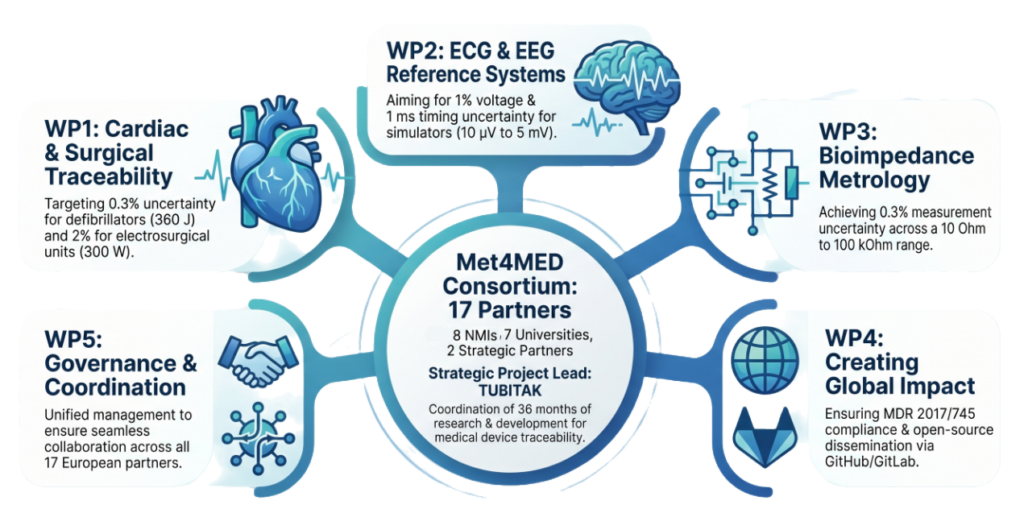
The aim of this work package, lead by TUBITAK, is to develop, evaluate, and validate advanced calibration systems for defibrillator analysers (ranging from 50 J to 360 J) and electrosurgical (ESU) analysers (up to 300 W and 1 MHz). The work includes the definition of technical specifications, functionality testing, and the establishment of traceable measurement systems. In total, three primary measurement setups will be constructed and compared across partner national metrology institutes to ensure international traceability and harmonisation.
For defibrillator analysers, the focus is on developing traceable high-voltage (HV) and high-current (HC) impulse measurement setups with a target expanded uncertainty of 0.3%. For electrosurgical units, the work package aims to optimise high-sensitivity broadband measurement equipment to handle complex modulated waveforms with a 2% power measurement uncertainty. A significant innovation in this work is the implementation of a hybrid analysis approach; traditional signal processing techniques, such as Fourier mode decomposition, will be integrated with Artificial Intelligence and Machine Learning (AI/ML) models (e.g., CNNs). These algorithms are designed to improve the accuracy and robustness of parameter extraction and transformation under variable and complex signal conditions.
Furthermore, the project will extend the modular Traceable Waveform Measurement (TWM) platform to automate the calibration procedures for both defibrillator and ESU analysers. This includes the development of a dedicated interface for automated testing according to IEC 60601-2-2 and IEC 60601-2-4 standards, which will allow for the execution of predefined test templates without human intervention, thereby increasing reproducibility. To ensure transparency and widespread dissemination, the AI/ML-based analysis methods will be integrated into an open-source GitHub pipeline. This fully characterised and automated reference system will provide a robust framework for secondary calibration laboratories and medical device manufacturers, ensuring the safety and essential performance of critical cardiac and surgical equipment.
WP2: Traceability and reference measurement system for ECGs and EEGs
The aim of this work package, lead by CMI, is to develop and validate a high-precision reference system for the calibration of ECG and EEG simulators. The project targets a measurement uncertainty of 1% in voltage amplitude and 1 ms in time intervals for low-level signals ranging from 10 µV to 5 mV (0.05 Hz to 150 Hz). This work is essential for ensuring the metrological traceability of medical diagnostic equipment and providing a technical basis for future updates to international normative standards, such as IEC 60601-2-25 and IEC 80601-2-26.
A core component of WP2 is the development of algorithm-based techniques for the characterisation of both biological and synthetic waveforms. By leveraging AI and Machine Learning (AI/ML) tools, the project will research and select new sets of standardised ECG and EEG waveforms from public databases (e.g., MIT-BIH, PTB-XL, and Temple University Hospital Corpus) to enhance the robustness of future device testing protocols. These algorithms will focus on critical diagnostic parameters, including time-domain features for ECGs and frequency band/amplitude levels for EEGs, ensuring that even complex anomalies are accurately captured and traceable.
On the hardware front, the work package involves the development and characterisation of specialised equipment, including low-noise amplifiers, high-resolution ADCs, and next-generation 16-bit DAC simulators. A key metrological highlight is the characterisation of these systems using quantum voltage standards, specifically Programmable Josephson Voltage Standards (PJVS) and Josephson Arbitrary Waveform Synthesisers (JAWS), to ensure primary-level accuracy. The final phase of the WP will implement and compare two independent reference systems—one based on direct sampling and the other utilizing low-noise amplification—validated through intercomparison. The outcomes will culminate in a comprehensive proposal to EURAMET and relevant standardisation bodies for the improvement of global ECG and EEG measurement standards.
WP3: Traceability for bioimpedance measurements
The aim of this work package, led by INRIM, is to establish a robust metrological infrastructure for Electrical Bioimpedance (EBI) measurements, covering an extended frequency range (up to several hundreds of kHz) and impedance magnitudes from 10 Ω to 100 kΩ. The project targets a calibration uncertainty of 0.3% for impedance meters and analysers, addressing a critical gap in the current medical field where the lack of traceable standards prevents reliable and comparable measurements in applications such as body composition analysis, malignancy detection, and cardio-respiratory monitoring.
A key focus of WP3 is the transition from oversimplified empirical models (e.g., Cole-Cole) to advanced parametric and data-driven models. By integrating AI and Machine Learning (AI/ML) algorithms, the work package will develop sophisticated techniques for noise reduction, artifact removal (such as motion and mains interference), and the estimation of complex nonlinear tissue parameters. These AI-based methods will be benchmarked against traditional parametric models to capture the frequency-dependent behaviour of human tissues more accurately. Furthermore, the project will investigate “non-idealities” such as stray capacitance and electrode-tissue contact impedance, which often compromise the accuracy of commercial EBI devices.
The hardware and methodology development includes the creation of traceable measurement benches, high-resolution EBI platforms, and passive tissue simulators that mimic realistic biological interfaces. These systems will be validated through multi-standard calibration schemes traceable to the SI. The final outputs of WP3 will include a comprehensive uncertainty model compliant with JCGM 102:2011 (GUM Supplement 2) and a Good Practice Guide (GPG). This guide will provide the international metrological and medical communities with standardised protocols for the traceable calibration of bioimpedance instrumentation, ensuring high-level accuracy and reproducibility in clinical and research settings.
WP4: Creating impact
The aim of this work package, lead by UNIBO, is to maximise the project’s socio-economic and scientific impact through a multi-faceted dissemination, communication, and exploitation strategy. By bridging the gap between metrological research and clinical application, WP4 ensures that the project’s outputs—ranging from calibration systems to AI-driven algorithms—are effectively integrated into the healthcare industry, regulatory frameworks, and academic curricula.
A central element of this work package is the establishment of a Stakeholder Committee comprising over 20 members from industry, clinical engineering, and standardisation bodies. This committee provides an external perspective to ensure that project results meet real-world clinical needs. Dissemination activities are extensive, including the presentation of at least 22 papers at major international conferences (e.g., IEEE I2MTC, CPEM, IMEKO) and the publication of at least 6 scientific papers in high-impact peer-reviewed journals such as Metrologia and IEEE Transactions on Instrumentation and Measurement. Furthermore, the project maintains a strong digital presence through a dedicated public website, social media engagement (LinkedIn and X), and open-source repositories (GitHub/GitLab) to ensure the transparency and reproducibility of developed software and data.
WP4 also focuses on the direct exploitation of four key expected results: traceable calibration systems for defibrillator analysers, electrosurgical (ESU) units, ECG/EEG simulators, and bioimpedance measurement platforms. By liaising with international standardisation organisations—including IEC TC 62, ISO TC 210, and OIML TC 18—the consortium aims to influence future updates of safety and performance standards (e.g., IEC 60601 series). Additionally, the project fosters long-term impact through academic uptake, integrating research findings into university-level courses and proposing master’s and doctoral theses. Ultimately, these efforts are designed to enhance patient safety, reduce legal liabilities for healthcare providers, and contribute to the European Partnership on Metrology’s economic KPIs by supporting the commercialisation of significantly improved medical measurement services.
WP5: Management and coordination
The aim of this work package, lead by TUBITAK, is to provide a streamlined strategic, technical, and administrative framework to ensure the successful execution of the project. Central to this WP is the establishment of a Project Management Board (PMB), comprising representatives from each beneficiary and all work package leaders. Under the leadership of the Coordinator, the PMB is responsible for overseeing the project’s progress, implementing rigorous risk management strategies, and ensuring that all ethical guidelines are strictly followed throughout the 36-month duration.
The coordination structure facilitates continuous collaboration through a series of five formal project meetings, including the kick-off (M1), mid-term (M18), and final (M36) meetings, supplemented by interim progress reviews at M9 and M27. These meetings, which rotate among the participating national metrology institutes, are designed to align technical activities and ensure that all partners are clear on their roles for the subsequent periods. In addition to formal sessions, ad-hoc technical meetings are held to address specific work package challenges, fostering an agile and responsive management environment.
A comprehensive reporting and monitoring system is implemented to comply with EURAMET and European Commission requirements. This includes the delivery of Interim and Periodic reports, financial statements, and updated Publishable Summaries at key milestones. WP5 also oversees the maintenance of critical strategic documents, such as the Data Management Plan (DMP) and the Dissemination, Communication, and Exploitation (DCE) plan. By ensuring administrative efficiency and transparent communication, WP5 guarantees the timely delivery of all scientific objectives and the robust management of the project’s overall impact.